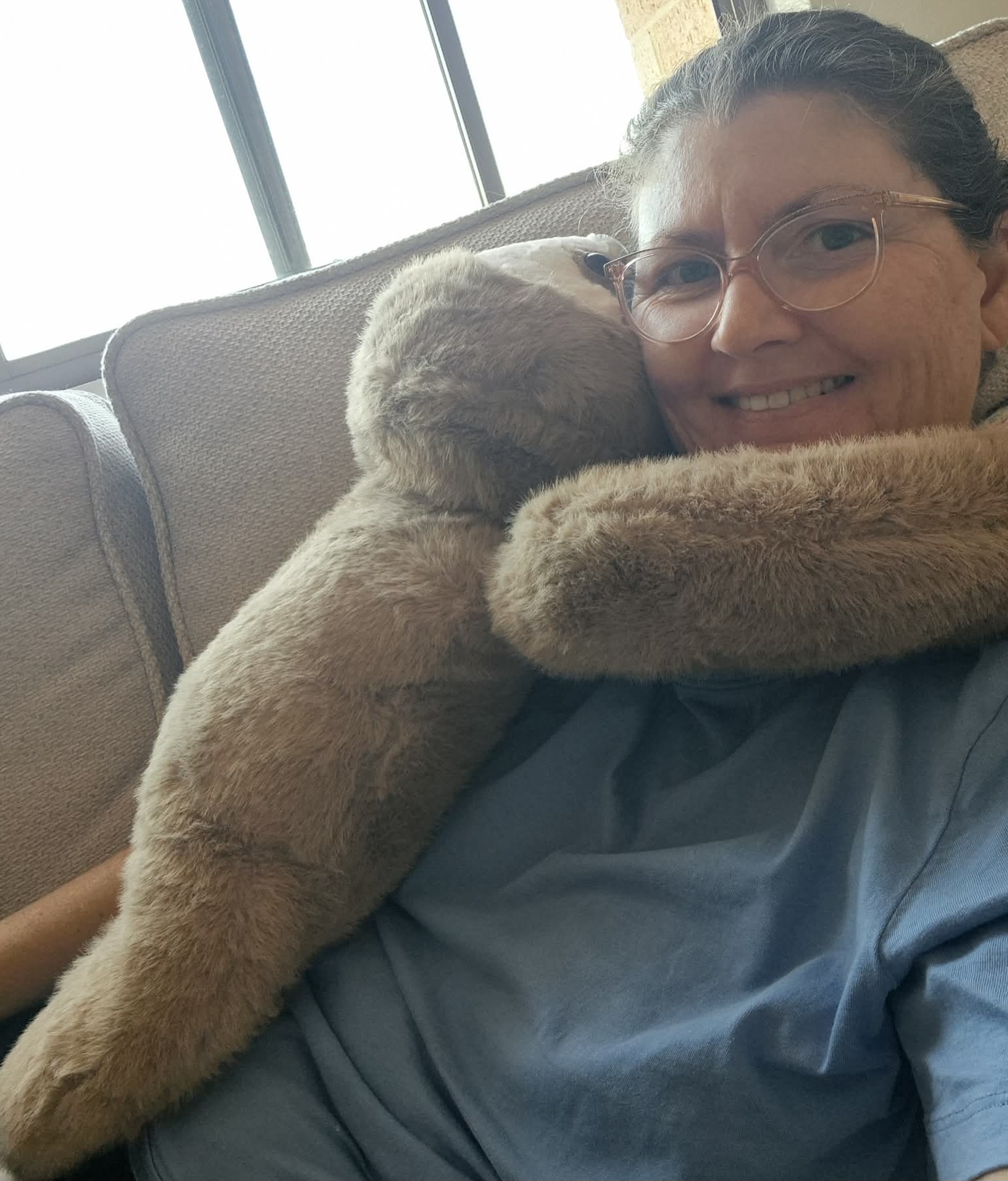
Anxiety rarely announces itself clearly. It often starts as a tight chest, shallow breathing, or a mind that loops the same worry on repeat. For some people it spikes in crowds; for others it arrives at bedtime or during a high-pressure task. Whatever the trigger, the body is signalling that it feels unsafe — and one of the fastest, drug-free ways to interrupt that signal is deep pressure stimulation.
A weighted sloth like Sally delivers that pressure in a soft, portable form. It is not a cure for anxiety disorders, but it can be a surprisingly effective part of a calm-down toolkit for adults, teens and children who need help settling their nervous system.
What anxiety does to the body
When anxiety kicks in, the sympathetic nervous system — the fight-or-flight branch — takes the wheel. Heart rate rises, muscles tense, breathing quickens, and cortisol (the body's primary stress hormone) begins to circulate. This response is useful if you are in genuine danger, but when it fires during everyday moments it leaves you wired, exhausted and unable to focus.
Calming anxiety is not just about thinking happier thoughts. It is about convincing the body that it is safe. That is where deep pressure comes in.
How deep pressure calms the nervous system
Deep pressure stimulation (also called deep touch pressure) is the steady, evenly distributed sensation you get from a firm hug, a weighted blanket or a heavy lap pad. Research suggests this kind of pressure activates the parasympathetic nervous system — the rest-and-digest branch — which helps slow the heart rate, relax the muscles and reduce circulating cortisol[1, 2].
In practical terms, the weighted object becomes a physical anchor. Instead of the body racing, it has something steady to feel. The sensation is grounding, predictable and comforting — exactly the opposite of the scattered, alert feeling that anxiety creates.
Why a weighted stuffed animal works for anxiety
Weighted blankets are well known, but they are not always practical. They are bulky, hot and hard to take to school, work or the car. A weighted stuffed animal gives you many of the same benefits in a smaller, more socially acceptable package.
Here is why people with anxiety often prefer a weighted plush:
- It is discreet. A soft sloth on your lap looks like a comfort item, not a therapy device.
- It is portable. You can move it from the couch to the desk to the car without fuss.
- It gives you something to hold. Tactile input — the feel of soft fabric, the weight in your hands — adds an extra layer of grounding.
- It can be placed where you need pressure most. Across the chest, over the shoulders, in the lap or hugged against the stomach.
What the research says
Most studies have focused on weighted blankets and vests, but the underlying mechanism applies to any weighted item that delivers consistent pressure. A systematic review of weighted blanket use found evidence of reduced anxiety and physiological arousal in a range of clinical and non-clinical populations[1]. Other research has linked deep touch pressure to lower heart rate and calmer behaviour in children with attention and sensory difficulties[3, 4].
Occupational therapists commonly use weighted tools and deep-pressure strategies to help children and adults with autism, ADHD and sensory processing challenges regulate their nervous systems[5]. The same principles apply whether the tool is a vest, a blanket or a weighted stuffed animal.
Why a sloth shape is especially soothing
Not all weighted plushes are designed the same way. A sloth's naturally long arms make it ideal for draping across the body, which is exactly how deep pressure works best. Sally's arms can rest over the shoulders, across the lap or around the chest, so the weight lands where it is most calming.
At about 1.1 kg, with the weight split between both hands, Sally is heavy enough to register as grounding pressure without being overwhelming. The soft outer fabric and gentle embroidered face add tactile comfort without the distraction of hard plastic parts.
Who a weighted sloth can help
- Adults with generalised anxiety or everyday stress — a weighted companion on the couch or desk can interrupt the spiral.
- Teens with exam or social anxiety — discreet enough to use in a bedroom or study space.
- Children with anxiety, autism or sensory processing differences — a friendly shape makes co-regulation easier at bedtime or after school.
- People with ADHD — the lap pressure during focus tasks can reduce restlessness and support concentration.
How to use a weighted sloth for anxiety
You do not need a complicated routine. Try one of these approaches:
- During a worry spike: Hold the sloth against your chest, breathe in for four counts, hold for four, out for six. Let the weight remind your body it is safe.
- At bedtime: Drape the sloth across your upper body while you read or wind down.
- While working: Rest the sloth in your lap to add steady proprioceptive input without stopping your hands.
- In the car or on a trip: Place the sloth across your lap to reduce travel anxiety.
Meet Sally, the weighted sensory sloth
Sally is a 1.1 kg weighted sloth designed for calm. Her long, weighted arms drape gently across the body, delivering the kind of deep pressure that helps quiet an anxious mind. Free shipping across Australia.
Buy Sally — AU$65A gentle safety note
As a general therapeutic guideline, weighted sensory items should be approximately 10% of the user's body weight. Sally is not recommended for children under 3 years old or for anyone unable to remove the item independently. If you are managing a diagnosed anxiety disorder, a weighted companion can be a helpful support tool but should not replace professional treatment.
References
- [1]Eron K, et al. Weighted Blanket Use: A Systematic Review. American Journal of Occupational Therapy (2020). https://pmc.ncbi.nlm.nih.gov/articles/PMC9216399/
- [2]Mullen B, et al. Exploring the Safety and Therapeutic Effects of Deep Pressure Stimulation Using a Weighted Blanket. Occupational Therapy in Mental Health (2008). https://www.tandfonline.com/doi/abs/10.1300/J004v24n01_05
- [3]Chen H-Y, et al. Physiological effects of deep touch pressure on anxiety alleviation. Journal of Medical and Biological Engineering (2013). https://link.springer.com/article/10.5405/jmbe.1043
- [4]Reynolds S, et al. Effects of weighted vests on heart rate and behavior in children with attention difficulties. American Journal of Occupational Therapy (2015). https://research.aota.org/ajot/article-abstract/69/3/6903220020p1/6014
- [5]Bestbier L, Williams TI. The Immediate Effects of Deep Pressure on Young People with Autism and Severe Intellectual Difficulties. Occupational Therapy International (2017). https://onlinelibrary.wiley.com/doi/10.1155/2017/7534972
Keep reading: Weighted Stuffed Animals for Sensory Overload: A Calm-Down Guide